
Betika in Ethiopia: licence record, host checks and payment exposure
Two hosts can look identical on a phone screen and behave nothing alike. Ethiopian search interest in Betika is shaped almost entirely by that gap: traffic arrives from a forwarded link, a group chat or a store listing with a familiar badge, and the deposit leaves before anyone confirms which address received it. Two separate questions follow, and they need separate answers. First, whether the address in the bar is the registered name the brand publishes. Second, whether Ethiopian public record currently permits betting with any sports-betting service at all. The second question has a dated, official and adverse answer, and it changes what a careful reader should do about the first.
Start with the lookalike host test
The check that protects the most money is mechanical rather than analytical. Expand the address bar to its full form instead of the shortened version a mobile browser shows, then read the host from the right: top-level domain first, registered name next, and only then whatever sits to the left of it. Copied front ends survive on the parts readers skip, such as a familiar word added before the dot, a hyphen dropped into the middle of the name, or a letter swap that is nearly invisible in a condensed font.
Three further details cannot be faked convincingly by a copied layout: the recipient name shown at the moment a transfer is confirmed, the support channel published on the verified host itself, and the publisher behind any downloadable application package. One mismatch is reason enough to stop, however complete the sportsbook, live odds and cashier appear.
| Check | How to read it | A mismatch means |
|---|---|---|
| Full host string | Expand the bar; read registered name and top-level domain | A copied front end, not the brand |
| Added words or hyphens | Compare character by character with your bookmark | A separate service using the same layout |
| Country code | Local-looking codes are cheap to register | No local standing is implied |
| Application package | Compare the store publisher with the verified host | Repackaged app may capture credentials |
| Payment recipient | Read the merchant or wallet name at confirmation | Funds are leaving to a third party |
| Padlock icon | Encryption only, never identity | Nothing about authorisation is proved |
Apply the same reading to mirrors. Links shared in group chats often point at a forwarding host that reaches the intended front end today and a credential-harvesting copy after the domain changes hands. Bookmark the host once verified, type it manually when the bookmark fails, and treat any forwarded address as unverified until it passes the same reading. Route-level host verification notes sit in the legal checks index.
The exact host string, and what a clean match cannot prove
betika.com is the registered name Ethiopian readers are usually trying to reach, and a clean match means the front end belongs to the brand rather than an imitator. That is a narrow finding. It says nothing about which legal entity holds the customer contract, which company controls the deposit account, whose terms govern a disputed balance, or whether the service may lawfully accept an Ethiopian bet today.
Those facts are independent, and none of them are visible in a browser. A correct host with no identified local entity leaves a player with a counterparty they cannot name, which matters at exactly the moment it becomes relevant: a frozen balance, a failed identity check or a closed account. Where the captured record holds nothing, the entry below reads unknown instead of being filled with a plausible guess.
| Item | Recorded position |
|---|---|
| Host checked | betika.com |
| Ethiopian licence | None current; category-wide revocation effective 15 December 2025 |
| Legal entity | Not identified in captured Ethiopian sources |
| Signal | Red, on an official adverse record |
| Payout testing | None conducted; no timestamped withdrawal recorded |
| Local context found | Business-directory presence only |
Operator record for Ethiopian traffic
No captured Ethiopian record names a legal entity, a registration number or a local licence holder behind the service. That gap is not a neutral detail. Where an operator is named and registered, a player has a party to complain about, a regulator that can be asked about that party, and a paper trail when a balance is disputed. Where no entity is named, a complaint has no addressee beyond the site's own support desk.
The single Ethiopian-facing item located during the same check is a business-directory listing. Directory presence documents that the name circulates in local search and listing context; it is not a licence, a company registry extract, a regulator record or an endorsement. Listings of this kind are commonly self-submitted and rarely reviewed after publication.

Licence status after the December 2025 revocation
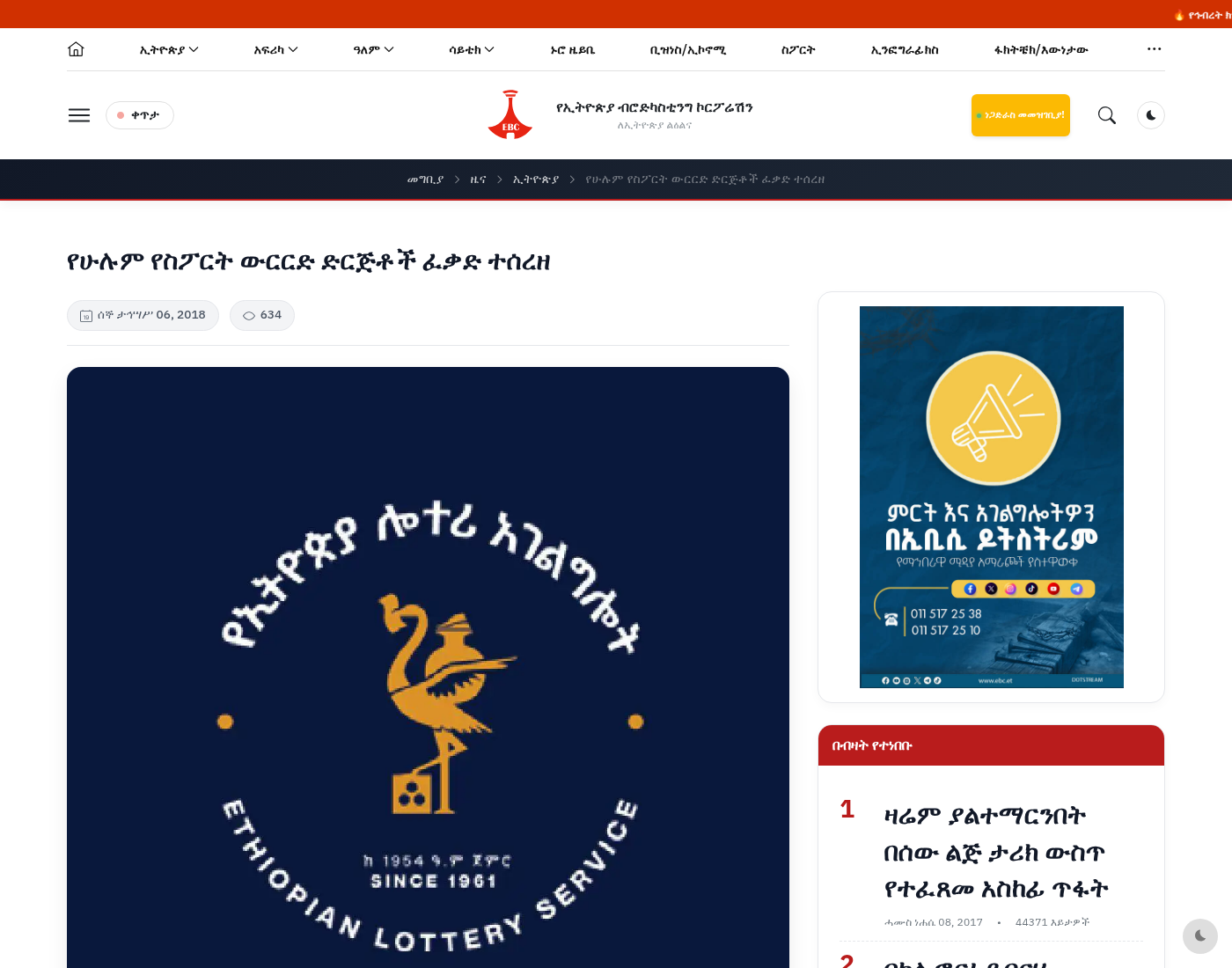
On 15 December 2025 a revocation of all sports-betting organisation licences took effect. The Ethiopian Broadcasting Corporation reported the Ethiopian Lottery Service announcement of that decision, and the item was re-checked on 28 August 2026: EBC report of the revocation. The regulator states on its own site that it issues licences and regulates private lottery activity under its establishing framework, which is the source of its authority over the sector: Ethiopian Lottery Service.
The scope of that action is why the signal is red. A category-wide revocation removes the lawful basis for the whole sector, so the service cannot be described as licensed in Ethiopia while the decision stands, whatever a footer, promotional banner or third-party badge asserts. Footer text is a claim by the operator; a revocation record is a decision by the regulator, and the two are not comparable forms of evidence.
The limits matter as much. Nationwide action is not brand-specific misconduct, does not establish that any particular deposit was taken dishonestly, does not authenticate any mirror domain, and does not resolve a balance held before the effective date.
The July 2026 warning and the 9695 reporting line
Seven months later the position had not moved. A July 2026 warning from the regulator restated that no sports-betting operator is currently licensed in Ethiopia and published 9695 as the number for reporting operators still taking bets: report of the July 2026 warning.
Two consequences follow for anyone weighing a deposit. A service that keeps accepting Ethiopian stakes after that warning sits outside the current framework by the regulator's own description, so the familiar consumer route of complaining to a licensing authority about its licensee does not exist in normal form. In its place, a player's own report becomes the useful action, and the hotline exists so that continued activity can be recorded.
Keep any report specific. The host string exactly as typed, the date and time, the amount, the payment method, the recipient name shown at confirmation and the account identifier are what make a report usable; a report naming only a brand is far weaker. Escalation formats are set out in the complaint route.
Deposit, login and data exposure while status is unresolved
Exposure on an unlicensed host is not limited to the stake, and the losses that are hardest to reverse are usually not the deposit itself. Each step of the funnel hands over something different.
| Step | What leaves your control | Practical consequence |
|---|---|---|
| Registration | Phone number, name | Marketing and resale exposure |
| Deposit | Funds and a wallet trail | Recovery depends on the payment provider |
| Password reuse | One credential set | Other accounts become reachable |
| Identity upload | Copy of an official document | No enforceable deletion route |
| Withdrawal request | Balance held pending checks | No external referee for the delay |
| Sideloaded application | Device permissions | Broad access to a personal handset |
The identity step deserves separate thought. A copy of a national identity document, held by a company that cannot be named, in a jurisdiction that cannot be identified, has no realistic deletion path: no supervisory body to ask, no retention period a player can enforce, no confirmation that the copy was ever destroyed. Password reuse compounds it, because a credential set that also unlocks a wallet or an email account turns one questionable registration into a wider compromise.
None of the above argues for swapping one unlicensed host for another. If comparison remains the goal, work from the reviewed operator index, apply the same host reading to every entry, and keep spending limits in view alongside the responsible gambling notes. View the catalogue route
Withdrawals and identity checks
No payout test has been carried out on the service, and none is claimed. A withdrawal test is the one check that cannot be inferred: either a deposit was made, a bet settled, a withdrawal requested and a dated outcome recorded, or nothing is known. Any processing time, limit or approval rate quoted without that chain is a repetition of promotional copy.
What can be said is structural. Identity verification is normally triggered by a first withdrawal rather than a first deposit, which is why money moves in easily and stalls on the way out. Without a current local licence, that pause has no external referee: if documents are requested, rejected, re-requested or met with silence, there is no licensing authority to escalate to, and payment-provider dispute rules become the only lever, often a weak one for gambling transfers.
With a pending balance, request the withdrawal in writing through the support channel published on the verified host, keep every reply, capture the balance and pending status with a visible date, and stop depositing while the request is open. Method-level detail sits in the payment notes.
Continue from the evidence file
If money is already involved
Sequence matters more than effort. Stop new transfers, secure shared credentials, document, then report.
- Stop further transfers and cancel any recurring authorisation on the wallet or card used.
- Change the password anywhere it was reused, starting with email and mobile money.
- Save the evidence: full host string, confirmation screens, recipient names, dates, amounts and support transcripts.
- Send a written withdrawal or refund request to the channel published on the verified host and keep the timestamp.
- Report continued operation on 9695, quoting the host string and transaction details.
- Open a dispute with the payment provider that moved the funds, using the same evidence set.
If the amount, frequency or secrecy of the spending has become the larger problem, the money route is the wrong first stop. Immediate support options are listed under urgent help, and blocking tools under self-exclusion.
Evidence chronology, ledger and limits
Every entry below was checked on 28 August 2026, and each is held at a stated tier so that a regulator decision is never read as equivalent to a directory entry.
| Source | Dated event | Tier | Supports | Does not support |
|---|---|---|---|---|
| ET-S002 | Revocation effective 15 December 2025, as reported | Primary | Loss of licensed status across the category | Any brand-specific misconduct |
| ET-S001 | Regulator framework statement | Primary | Who issues and supervises licences | Any current licence for the operator |
| ET-S003 | July 2026 warning; 9695 line | Primary | No operator currently licensed | Outcome of an individual balance |
| ET-S037 | Directory listing captured 28 August 2026 | User context | Public visibility of the name | Licensing, safety or wrongdoing |
The ledger is deliberately short, and the gaps are part of the reading: no named legal entity, no dated payout record, no authentication of mirror hosts, and no record settling balances held before the revocation date. Complaints circulating in public forums remain allegations unless a dated competent record resolves them.
How the reading was built, and how to correct it
The signal follows a fixed rule rather than an impression. Green requires current primary evidence tied to the exact host and entity. Red requires an official adverse record or corroborated documented evidence. Everything else stays amber. Here the adverse record is official, dated and category-wide, so red is the only defensible reading, and the basis is logged as official adverse rather than as a finding about the brand's conduct.
Roles are kept apart on purpose. Regulator publications and the reporting of a regulator announcement are primary; anything the operator says about itself is an operator claim; directory, forum and review presence is context that proves visibility and nothing more.
Records change. A restored or newly issued licence, a disclosed local entity, or a documented payout would each move the reading, and the dated ledger exists so that a change can be shown rather than asserted. Corrections carrying a dated primary source are welcome through the contact route; the scoring rules sit in the method notes and the publication standards in the editorial policy.
Questions readers ask
Is Betika a scam or legit in Ethiopia?
Neither label is supported by the captured record. What is documented is that no sports-betting operator holds a current Ethiopian licence after the revocation effective 15 December 2025, restated by the regulator in July 2026. That makes betting from Ethiopia unlicensed rather than proven dishonest. No dated record of stolen funds or manipulated markets was located.
Is betting with this operator legal in Ethiopia right now?
Not within the licensing framework. All sports-betting organisation licences were revoked with effect from 15 December 2025, and in July 2026 the Ethiopian Lottery Service stated publicly that no sports-betting operator is currently licensed. A site accepting Ethiopian stakes today is doing so outside that framework, whatever a footer or banner claims.
How do I know I am on the genuine host and not a copy?
Expand the address bar and read the registered name and top-level domain in full, then check the recipient name at payment confirmation, the support channel published on that host, and the publisher of any application package. Added words, inserted hyphens, letter swaps and unfamiliar country codes are the usual tells. A padlock proves encryption only, never identity.
My withdrawal has not arrived. Who can I complain to?
No licensing authority supervises an unlicensed operator, so escalation runs through the payment provider that moved the funds and through the regulator's 9695 line, which exists for reports of operators still taking bets. Submit the withdrawal request in writing first, keep every timestamp, host string and confirmation screen, and stop depositing while it is open.
Does the revocation mean the brand was caught doing something wrong?
No. The action removed licences across the whole sports-betting category rather than penalising one named company, and nothing in the captured record ties it to specific misconduct by the operator. It does mean the service cannot be described as licensed in Ethiopia while the revocation stands, which is a status finding, not a fraud finding.
Has a withdrawal actually been tested on the service?
No. No deposit, settled bet or dated payout has been recorded, so no processing time, limit or approval figure is quoted. Where such a test exists it is reported with dates and amounts; where it does not, the gap is left visible rather than filled with numbers repeated from promotional material.
Financial Intelligence Service / Federal Gazette copy