
Hulusport in Ethiopia: Licence and Risk Review
Bottom line: the licence position changed
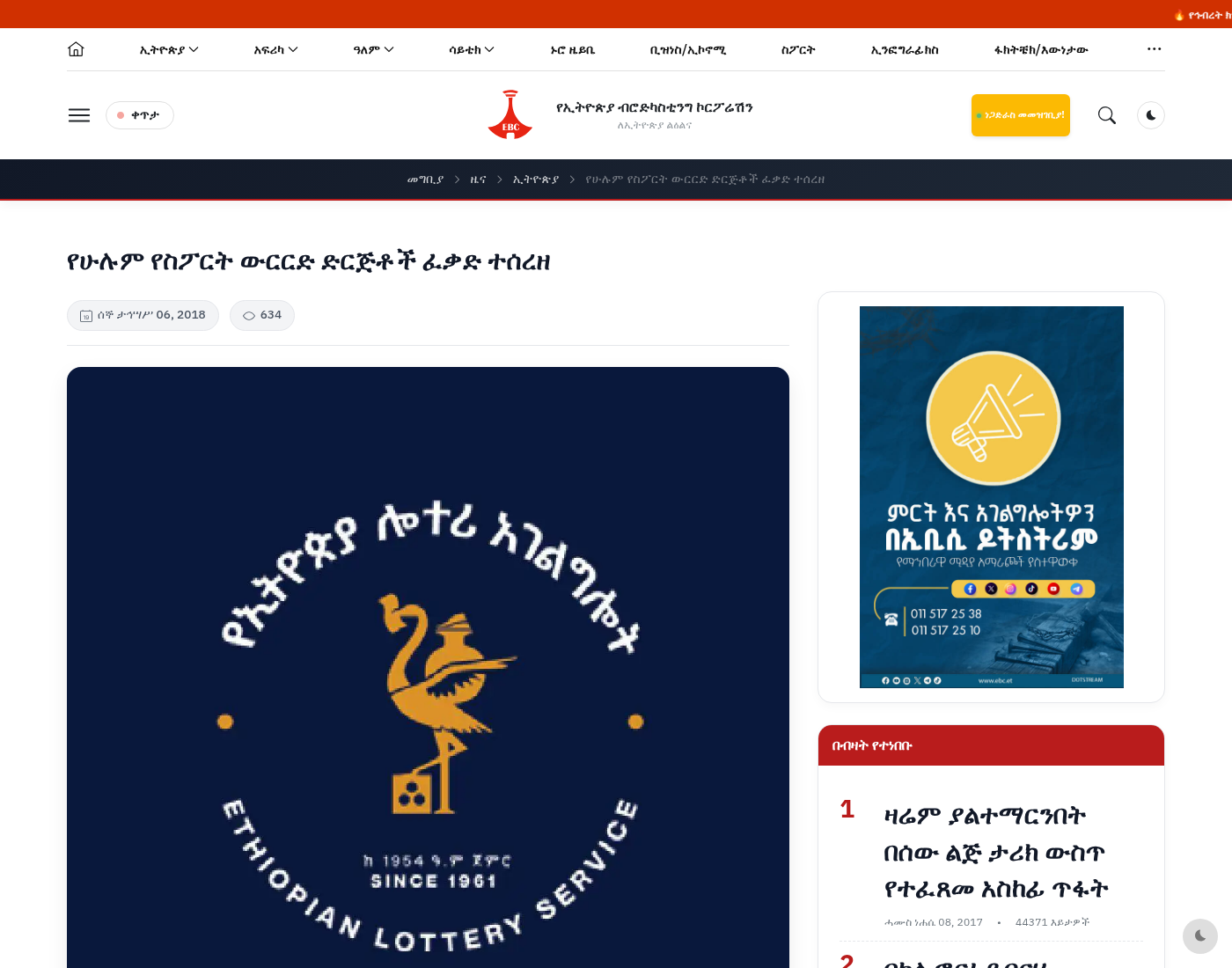
The most important fact is dated. The Ethiopian sports-betting licensing position changed when the Ethiopian Lottery Service (ELS) revoked all sports-betting organisation licences with effect from 15 December 2025. The announcement is reported by the Ethiopian Broadcasting Corporation. A later July 2026 warning reported that no sports-betting operator was currently licensed in Ethiopia. On the evidence available, a service accepting Ethiopian sports bets after that change cannot be treated as locally licensed merely because it displays a licence claim, uses Ethiopian language, or appears in local search results.

Our signal is red because the adverse finding is an official, nationwide licensing action. This is a regulatory-status conclusion, not a finding that the named service committed fraud or that every customer experienced a loss. The captured evidence does not identify the operator, settle any customer balance, authenticate every mirror domain, or establish brand-specific misconduct.
| Question | Evidence-led answer |
|---|---|
| Is there a current Ethiopian sports-betting licence? | No current Ethiopian sports-betting licence is supported by the supplied records. |
| When did the nationwide revocation take effect? | 15 December 2025. |
| Is the operator identified? | Not in the captured sources. |
| Does local online visibility prove legitimacy? | No. Public visibility is context, not licensing proof. |
What the regulator record establishes
The ELS says it issues licences and regulates private lottery activity under its establishing framework. That makes the licensing authority’s status information more relevant than a site footer, promotional post, affiliate description, or customer comment. The ELS website is the primary institutional reference supplied for that role.
The EBC report records the ELS announcement that all sports-betting organisation licences were revoked effective 15 December 2025. The wording matters: the record supports a nationwide action affecting the category, rather than a narrow warning about one website. It therefore answers the local legal-status question more directly than a brand review based on interface features.
The evidence does not show a new licence granted to this service after the revocation. It also does not provide a licence number, licensed legal entity, approved domain list, expiry date, or official statement linking the service to a permitted operator. Those omissions do not prove deception, but they prevent a positive licence finding.
Chronology of the available evidence
| Date | Record | What it supports | What it does not support |
|---|---|---|---|
| 15 December 2025 | ELS announcement reported by EBC | All sports-betting organisation licences were revoked from this date. | Brand-specific wrongdoing or the outcome of an individual account. |
| 28 August 2026 | Evidence review date | The supplied records were checked on this date. | A live test of the website, payments, withdrawals, or support. |
| July 2026 | ELS warning reported by Stockmarket.et | No sports-betting operator was currently licensed, and hotline 9695 was recorded. | A finding that every online betting brand is fraudulent. |
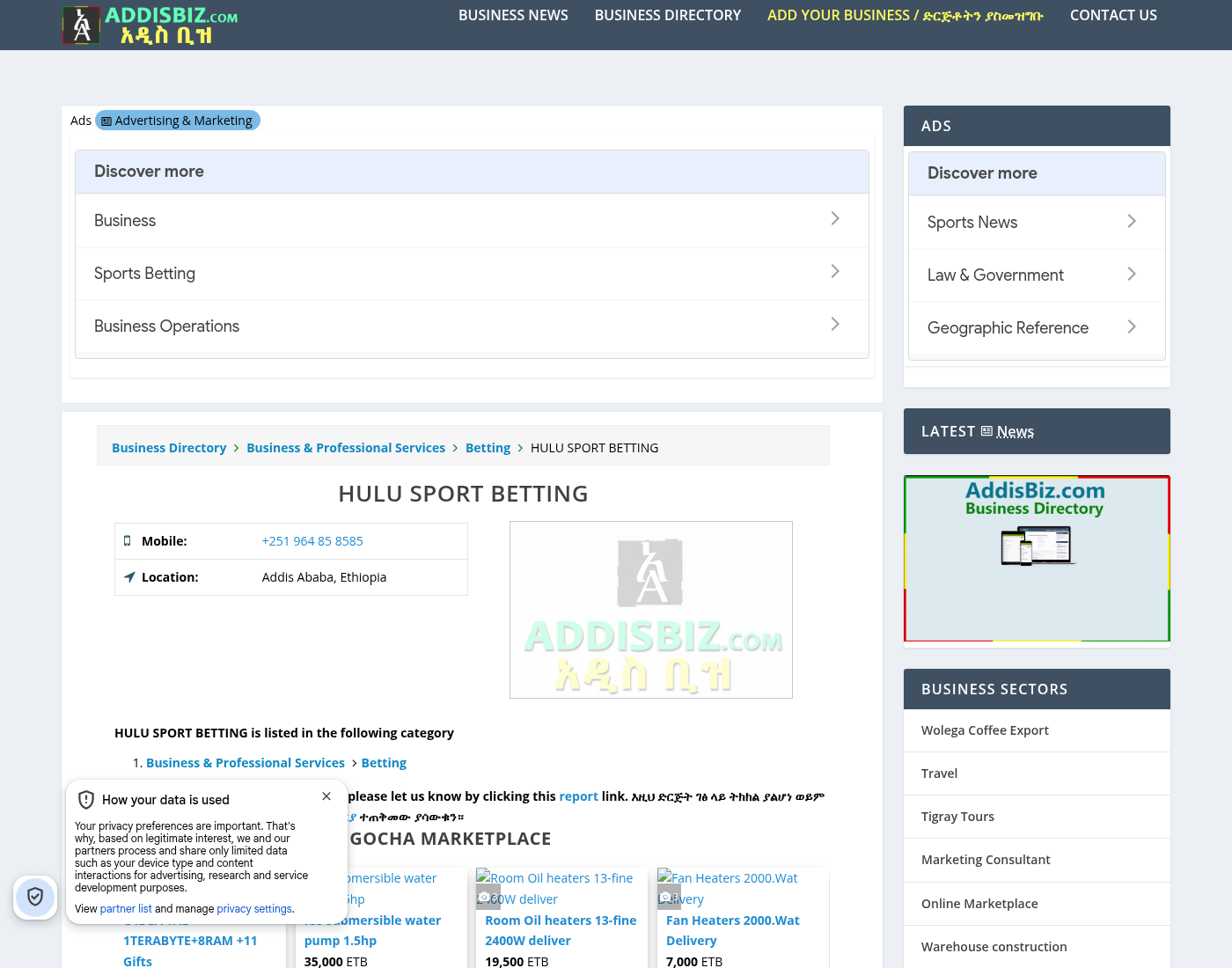
| 28 August 2026 | Public directory context | The brand appears in public business, review, forum, or search context. | Licensing, safety, solvency, or misconduct. |
The later warning is reported by Stockmarket.et. It reinforces the current-status concern, but the supplied packet still does not contain a brand-specific enforcement decision. Readers should distinguish “not currently supported as licensed” from “proven scam.”
Entity, host and domain checks
The requested host is hulusport.com. The captured sources do not identify the legal entity operating it. That means the visible brand, the domain registrant, a payment recipient, and any company named in terms may be different parties; the supplied evidence cannot tell us whether they are connected.
A reliable identity match normally requires the same legal name and licence details to appear in a current primary register, together with the precise domain being used. A logo or familiar name is not enough. Neither is a promise that an offshore company accepts Ethiopian customers. A foreign registration, if one were claimed, would not by itself establish permission to offer sports betting in Ethiopia.
| Identity item | Result from the supplied packet | Practical implication |
|---|---|---|
| Requested domain | hulusport.com | Treat the exact host as unverified for Ethiopian licensing. |
| Legal operator | Not identified in captured sources | The party responsible for funds and complaints is unclear. |
| Ethiopian licence number | Not supplied | No licence match can be completed. |
| Approved domain relationship | Not supplied | A mirror or clone cannot be ruled out. |
| Public context | Present in a directory-style record | Visibility is not regulatory approval. |
Check the address bar character by character before entering credentials. Look for added hyphens, substituted letters, unusual subdomains, shortened links, or a different top-level domain. A copied logo and similar colour scheme can make a clone look convincing. The independent context capture shows public reference to the name, but it is not a regulator record and should not be used as proof of safety.
Is it a scam or legitimate service?
The available evidence does not establish that the service is a scam. It also does not establish that it is a legitimate, currently licensed Ethiopian betting operator. The responsible conclusion is that its local regulatory status is not acceptable for a green rating and that customers face a significant legal and payment-risk warning.
“Legitimate” can mean several different things: a real website, a functioning account system, an identifiable company, a licensed operator, or a service that honours withdrawals. These are separate questions. A website may load and accept registration while still lacking local authorisation. A customer may receive a small payout without that proving future withdrawals, solvency, or lawful operation.
Our red signal is limited to the official adverse licensing evidence. It should not be expanded into unsupported allegations about theft, fake games, rigged outcomes, money laundering, or individual staff. No such claim is established by the supplied records. Conversely, users should not interpret the absence of a proven scam finding as a safety recommendation.
Payments and deposits
No verified payment method, deposit test, transaction receipt, fee schedule, processing time, or payment-risk assessment is supplied. We therefore cannot confirm whether deposits are processed by a bank, mobile-money service, card processor, voucher provider, or an intermediary. Do not treat a payment icon on a betting interface as evidence that the recipient is authorised or that a refund is available.
Before sending money, record the exact recipient name, amount, date, reference number, and terms shown at the time. Avoid paying a personal account or sending funds after a support agent changes the instructions in a private chat. Never share a one-time password, card security code, banking password, or identity document with an unverified contact.
| Payment question | Verified position | Safer approach |
|---|---|---|
| Which methods are accepted? | Not established in the evidence packet. | Do not infer availability from icons or advertisements. |
| Who receives the money? | Operator and payment recipient are not identified. | Confirm the legal recipient before paying. |
| Are fees known? | No verified fee schedule is supplied. | Save the displayed terms and transaction receipt. |
| Is a refund guaranteed? | No refund evidence is supplied. | Assume recovery may be difficult if the service is unauthorised. |
| Has a deposit been tested? | No test was conducted. | Do not use a test deposit to justify larger exposure. |
Withdrawals, balances and KYC
There is no verified withdrawal test in the packet. We cannot state that withdrawals work, fail, are delayed, or are routinely completed. We also cannot confirm minimum withdrawal amounts, processing queues, identity checks, account closures, wagering conditions, confiscation rules, or the treatment of dormant balances.
A request for identity documents can occur for legitimate compliance reasons, but the absence of an identifiable licensed operator makes document sharing more sensitive. Before uploading an identity card, passport, selfie, address document, or bank statement, establish who will receive it, why it is required, how it will be protected, and where a formal complaint can be made. Do not send documents through an unverified social-media account.
If money is already at risk, preserve screenshots of the balance, deposit and withdrawal pages, transaction references, account messages, terms, and the exact domain. Do not alter screenshots or remove dates. Keep communication factual and avoid sending additional funds to “unlock” a withdrawal, pay a tax, raise a verification tier, or release a bonus unless an independently verified authority confirms the demand.
Complaint route and reporting options
The supplied July 2026 warning records the reporting hotline 9695. This is the clearest reporting route contained in the evidence packet. A complaint or report should identify the exact host, dates, payment references, claimed operator, amount involved, and the action requested. Attach original records where possible and redact passwords, full payment-card numbers, and unrelated personal data.
A report is not the same as a guaranteed recovery process. The supplied sources do not promise compensation, account restoration, or a decision for any individual. If a bank, card issuer, or payment provider was involved, contact that provider promptly using its official channel and ask what dispute or fraud-reporting options are available. Keep the provider’s case number.
| Problem | Records to preserve | Route indicated by the packet |
|---|---|---|
| Suspected unlicensed betting | Domain, advert, date, screenshots, payment details | ELS reporting hotline 9695. |
| Missing withdrawal | Account ID, request date, amount, messages, receipts | Payment provider and the relevant official reporting channel. |
| Impersonation or clone | Both addresses, copied branding, messages, redirect path | Report the precise host, not only the brand name. |
| Personal-data concern | Documents sent, recipient, date, account messages | Contact the provider and use an official complaint route. |
For a broader process overview, use the site’s complaints guidance. It does not replace an official decision and does not convert user reports into proven findings.
Clone, redirect and account-safety checks
A brand name can appear on more than one host. Compare the exact address in emails, adverts, browser history, payment instructions, and account messages. Pay attention to redirects after login, certificate warnings, unexpected download prompts, and requests to move a conversation to an unverified messaging account.
Use a unique password and enable multi-factor authentication where it is genuinely provided by the account service. If the same password was used elsewhere, change it on those other services first through their official sites. Review bank and mobile-money alerts, revoke unfamiliar sessions, and contact the relevant provider if credentials may have been exposed.
Do not rely on a padlock alone. Encryption protects the connection; it does not prove licensing, fair conduct, solvency, or the identity of the operator. Search results and directory listings can help locate a lead, but only a current competent primary record can support a precise licence conclusion.
What remains unknown
Several important questions remain open. The packet does not identify the operating legal entity, confirm ownership of the requested domain, provide a current Ethiopian licence, record a live account test, verify payment rails, test a withdrawal, or establish a formal brand-specific complaint outcome. It also does not prove whether any particular mirror is controlled by the same party.
These are evidence limits, not hidden conclusions. We have not filled the gaps with assumptions about where the company is based, whether games are fair, whether balances are recoverable, or whether support will respond. A claim made on the service itself would be an operator statement unless independently confirmed.
Method and correction path
This assessment gives primary regulatory records priority over operator marketing and public user context. The ELS institutional record establishes the regulator’s role. The EBC report supplies the dated nationwide revocation. The later report supplies the current warning and hotline. The directory-style record establishes only that the name appears in public context.
The review should change if a competent primary source publishes a current licence that names the legal operator and precisely covers hulusport.com, or if the regulator corrects or supersedes the adverse status. A corrected record should include the publication date, source URL, licence holder, licence number, covered domain, and effective period. Send documented corrections through the site’s contact route with the relevant primary record. Unsupported assurances, copied promotional text, or anonymous comments are not enough to reverse the signal.
For the site’s evidence standards, see methodology and legal checks. If you still choose to visit the service, use the exact address you independently verified and do not deposit while its Ethiopian licensing status remains unsupported. Continue from the file only after checking the current legal position; this link is not a licence, safety finding, or promise of payment.
Frequently asked questions
Is Hulusport licensed in Ethiopia?
No current Ethiopian sports-betting licence is supported by the supplied records. The ELS announcement reported by EBC says all sports-betting organisation licences were revoked effective 15 December 2025, and a later July 2026 warning reported that no sports-betting operator was currently licensed. The packet does not identify a subsequent licence covering hulusport.com.
Is Hulusport a proven scam?
No. The supplied evidence does not prove brand-specific fraud or misconduct. It does show an official adverse nationwide licensing position, an unidentified operator, and no verified current Ethiopian licence for the requested host. That combination warrants a red regulatory-risk signal without making an unsupported criminal allegation.
Can I trust the operator’s licence claim?
Not without a matching current primary record. Verify the legal entity, licence number, effective dates, permitted activity, and exact domain against the regulator’s information. A footer, logo, certificate image, social-media statement, or customer comment is not enough to establish a current Ethiopian licence.
Are deposits and withdrawals verified?
No. The packet contains no verified payment-method record, deposit test, withdrawal test, processing result, fee schedule, or balance-resolution outcome. Save transaction evidence and avoid sending additional money to release a withdrawal or complete a supposed upgrade.
What should I do if money is missing?
Preserve the exact host, account messages, screenshots, receipts, transaction references, dates, and amounts. Contact the bank or payment provider promptly through its official channel and ask about available dispute options. The supplied July 2026 warning records ELS reporting hotline 9695 for reports concerning unlicensed betting.
How can I report a clone or suspicious domain?
Record the full address, redirect chain, copied branding, messages, payment instructions, and dates. Report the precise domain rather than only the brand name. Do not upload passwords or unnecessary identity documents with the report, and do not assume that two similar hosts share the same operator.
Can this rating change?
Yes, but only with stronger dated evidence. A current primary record would need to identify the legal operator, show a valid Ethiopian sports-betting authorisation, and cover the precise domain. A correction or superseding notice from the competent authority could also change the assessment. Public visibility alone cannot do so.